Sunday, February 26, 2012

CALMLY DRIFTING


Dearest Readers,
Leap Day is coming...slip-sliding into our lives on Wednesday February 29th. It’s a gentle fabrication poked into our schedules every four years to let the world and calendar makers get square with earth’s 365 and ¼ day annual circuit around the sun. Some might call it a day of cosmic drift or a 24-hour free ride in deep space. Slippage corrected.

My friend Ruth Schowalter will be in the art show, “Correcting for Drift” with the opening on, you guessed it, this Wednesday, Leap Day at Georgia Perimeter College in Clarkston. http://www.facebook.com/groups/76015195632/doc/10150568020720633/


Ruth’s eponymous piece, “Correcting for Drift”, reveals a threshold into a dreamy oceanic world of biological and mythical beings. I thank her for tickling my imagination about this cosmic day.

Earth and I will be calm on Wednesday. Relaxed. I expect we’ll glide smoothly through the day–Me with some meditation, dog walking and the glacially slow, balanced moves of Tai Chi, and Earth with the precise mathematics of matter, velocity, and gravitational pull. Happy Free Falling Day!

Monday, February 20, 2012

PRESIDENTS’ DAY BOREDOM


Dearest Readers,
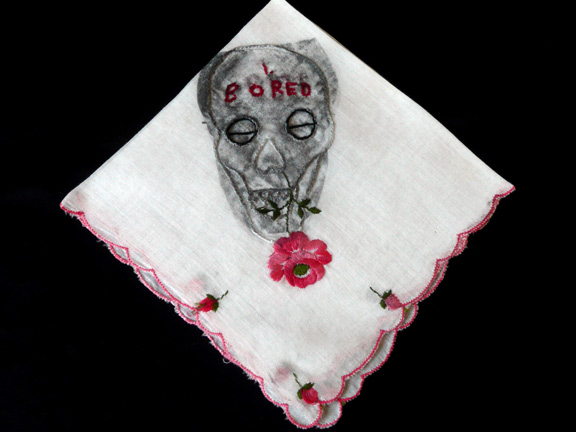
It’s a pretty dull day when I turn to contemplations of boredom, but over my past twenty-one years of art making, boredom has become a useful friend. On this pre-packaged, two-for-one presidential shopping sale holiday, I thought I’d share some artwork steeped in boredom or its process. Last week I pulled out another of my 89 daily bathroom mirror portraits of feelings. This photo was Day#1–Bored, and with it the embroidered hankie version. Not much life in these two, but a valid lack-of-emotion worthy of depiction. Last week I painted an oil stick portrait of my boring face–a winning trifecta of feeling dull.

When inspiration escapes me, I’ll often use the method of boredom to break through to wild mind. Here’s how it works. 1.Pin up a dozen or more sheets of paper on the wall.
2.Spread out a variety of drawing and painting media at easy reach. 3.Determine a subject to draw and stick to it. 4.Set a timer for a few minutes...maybe 5 or 10, and hit the start button. 5.When the alarm rings, I must move to the second sheet of blank paper, reset the alarm, start a new drawing, and so on until I am thoroughly bored, and frustrated with the short time-frame, and the repetitive subject. What invariably happens is I begin by drawing familiar images, or sometimes small, controlled and logical images. As I am forced to leave each piece when the bell goes off, I grab different media and gradually begin to try new approaches and more daring colors. Usually by the last sheet, I’ve moved out of the area of boring to a bigger field of creativity by just surrendering, and letting it rip. I did not invent this. Someone explained it to me in the early 90’s. I am indebted to their boring brilliance.

Here are eight drawings of holes or tunnels that I drew last summer using my breakthrough boring method. I’ve numbered them 1-8 so you can see the progression of loosening up. It works better than a glass of wine. My question to myself is, do I like the first one, last one or someplace in the middle?

Number one:


Number two:


Number three:


Number four:


Number five:


Number six:


Number seven:


Number eight:

Saturday, February 11, 2012

DEAR HEART


Dearest Readers,
I missed Valentine’s Day for this post, but it's never too late to honor a day devoted to matters of the heart–a symbol that keeps erupting in my artwork. Let’s hear it for love, courage, life, sympathy, compassion, sincerity, strength, hearty, heartfelt, and even heartsick–all straight from the heart.


I’m staying away these days from the Catholic Sacred Heart–symbol of suffering, self-sacrifice, and sadness. Let me not knock on that door today. It resides within, but buried deep inside.


Last week I finished an oil stick self-portrait on paper entitled Loved. It’s me as a heart loved by my family and friends.


This portrait began in 2010 as a photo I shot in my bathroom mirror entitled Day #80, from 89 days of examining my feeling of the moment, and writing it in lipstick on my forehead. Another way of asking...Who Am I?


Later I printed the mirrored-mirror image of my reflected face on one of my vintage hankies that I wore as a kid in the little breast pocket of my Catholic school uniform jumper.

Dear heart, I’ve depicted you in drawings and paintings, embroideries, clothing, dolls, wings and portraits. Thank you for persistently beating.


Heartfelt, ©2008
6 1/2” x 6 1/2”
Embroidery floss on vintage linen


Heart Sick, ©2010
7 1/4” x 7 1/4”
Embroidery floss on vintage linen


The Bravery Jacket, ©2007
Life sized
Acrylic on wool twill, aluminum buttons, braiding, yarn, gauze, nails and threads.


A Joyful Heart, ©2003
8" x 13" x 3"
Fabric, acrylic, found objects and polymer clay


Interwoven Hearts, ©2011
18 1/2 " x 22 1/4"
Charcoal and pastel on paper


Pangea Heart Holes, ©2011
11" x 14"
Charcoal, pastel and conté on paper


See Little Cece's heartbeat at

http://www.youtube.com/watch?v=iCg4GBG-bw4&feature=youtu.be

Saturday, February 4, 2012

FLYING LESSONS – A TO Z


ARMS BEATING


ANKLES BRACING


COASTING COLLAPSING


DARTING DIVING


ELEVATED EARTHLING


FLYING FALLING


GRACEFUL GROUNDLING


to the HEIGHTS into a HOLE


INSPIRED INVERTED


JUMP HIGH JUMP DEEP


KICK OUT KNOCK DOWN


LAUNCHING LANDING


MAINTAINING MOMENTUM MISSING THE MARK


out of the NEST into the NIGHT


ORBITING OBSTACLES


PASSING a PLANE


QUESTING QUEEZY


RISING RETURNING


SOARING SINKING


TRANSPORTING TUMBLING


UP UNDER


VAULTING VERTIGO


W I D E S P R E A D
W I N G S P A N
W I N D I N G D O W N


X-P-A-N-D X-H-A-L-E


YES YIKES


to the ZENITH from ground ZERO


Monday, January 30, 2012

DEAR MOTHER


Dearest Readers,
This is Jan Selman, an artist and women’s political coach who I met this weekend at a dinner party. She lost her 85 year old mother to cancer last year. Jan spoke at length about having hospice in her home, and how positive that experience was for her family and for her mom. Hospice care provided palliative medical treatment, and a compassionate bridge into death. The scenario, she noted, was better than dying in a hospital.

I squirmed as Jan’s story unfolded, realizing at some point that my mom’s hospice in 1997 in her Decatur Georgia nursing home, Harvest Heights, was far from homey. The setting felt like a hospital with nurses, aides, people in wheelchairs, and sanitized hallways flooded in neon. It was not bad, just not as personal.


I took this picture of Mom two months before she passed away. She had fallen, broken a hip and injured her eye. She was incontinent, and had dementia, but often still recognized me and was always cheerful. In the fall of that year she stopped eating and drinking. I initiated hospice care in her room at the nursing home after she was sent twice to The Atlanta Medical Center (formerly Georgia Baptist Hospital) to give her intravenous fluids, and stabilize her body chemistry. I made this tough decision after a meeting with her doctor and nurses, and in accordance with her living will wish for no extraordinary medical interventions.

Nothing much changed as far as the look of Mom’s nursing home room. It was now called hospice. We offered her food and drink, but did not force it. Mom was in a semi-private room with a curtain separating her from a woman with advanced Alzheimer’s. This woman lay in a fetal position by the window moaning or calling out. Her family, who I only saw once, kept a TV next to her that was turned on all day and probably all night–for comfort, I assume. During my mother’s last days on earth we sat with her while football games, commercials and talk shows played just beyond the curtain. It was disconcerting, but Mom did not seem to mind, and eventually slipped into a coma and died on December 6, 1997. For me the atmosphere in that room still feels surreal.


These are two portraits I drew of Mom based on the photograph. I covered her face in one of them, but I left her large eyes open so she could see through.


I took a final picture of Mom's hands while in hospice, and after her death I did a plan drawing for something I called “Helping Hand Wings for Hazel...Who Was Afraid of Death”. I imagined a zip-on winged contraption to enable her to pass fearlessly through the transition.

Two weeks ago I discovered two pictures of Mom as a teenager probably from 1923, and as a young adult around 1929 that touched me with their sweetness. They were pasted inside an old photo album she had stored in a footlocker in my basement. I include them here.


Sunday, January 22, 2012

SOMETHING ABOUT A FAMILY-The Story of a Painting


Dearest Readers,
I’m wrestling with a painting that says something about a family–mom, dad, daughter depicted as hearts curled up in seedpods that rise from the New Jersey wetlands. It took three years of iterations, influences and changes to get to this point. The image at the top of the blog is close to the final.


My artist friend Ruth Schowalter, aka Hallelujah Truth, http://coffeewithhallelujah.blogspot.com/ visited me in my studio on Friday, and suggested I think of the evolving piece as chapters in a novel, with twists and turns of plot, a title, and synopsis on the back cover. The idea of painting as a book gives me some distance, which helps me pull out meaning from this conundrum of a painting. Here’s one possible story...

Title: Something About A Family by Cecelia Kane

Back Cover Synopsis:
Something About A Family is a generational story that begins when the grown daughter, Little Cece, arranges three green pears on an enameled metal plate in 2008. She recognizes a similarity with an idyllic family photo of herself, her mother and father from Easter Sunday,1950 in Shrewsbury Vermont. Kane leads us on a journey through the eyes of Cece back to her roots near the industrial wetlands of urban New Jersey, reconstructing something about a family that cacooned itself against a tough gang-oriented cityscape. The family built a boat shaped like a plate, to navigate the canals and alleyways of an inhospitable city. Through birth, death and resurrection Cece, and the vibrant memories of her dead parents, are born again as harlequin hearts of love nestled in seedpods that rise above the swirling tides and dark nights of Cece's ordinary life–saved in the nick of time from sliding off the edge of the painting.

Chapter 1. 2008 Inspiration from a Plate of Pears (photo-recreation)


Chapter 2. 2008 Visual Connection With An Old Photo


Chapter 3. 2008 Hearts in the City, a mixed media drawing on paper created during a residency at the Hambidge Center in Rabun Gap Georgia, December 2008, 11” x 17”


Chapter 4. 2009
Hearts in the Lonely City, a painting based on the drawing.
It’s a colorful but inanimate rendition of Cece and her family afloat on that enamel plate in a flooded city in New Jersey. Some sort of egg-y goo threatens their ability to navigate this stiff, lifeless town. The father doesn’t match Cece’s memory of her dad who was kind, though mostly absent. Their harlequin garb is too perfect, too strange, too arbitrary. Acrylic on canvas, 40" x 32"


Chapter 5. 2009 Hearts at Home in Chaos, The painting now pulls the three family members together as a huddled mass of color into it’s own protected nest within the coiled streets of the city. Father’s eyes are emotionless sentinels. The plate-boat has morphed into a brick pathway and a new heart slides into the scene. Who is this? The buildings are engulfed in flames and flood. The buildings are more transparent in this version, and writhing in motion. This is industrial New Jersey suffering the effects of overcrowding, dirt and eco-devastation.


Chapter 6. 2009 Hate and Intervention, Cece cannot abide this painting. It does not speak the full truth of her family and early life. On another artist retreat to the Hambidge Center in the north Georgia mountains, Cece has a couple of glasses of wine at dinner, returns at night to her studio retreat, and paints big white ovals in circular brush strokes around the four heart forms. (No photo was taken of this phase...This picture is a Photoshop recreation.)


Chapter 7. 2010 More Interventions, Not knowing where to turn, Cece tries to find her family. She creates a large pond for the four hearts to float in. (This is also a rough recreation). The white circles become more egg-like.


Chapter 8. 2011
Dead Hearts Cece obliterates the windows, and changes the transparent buildings into planar boxes hugging the periphery of the family’s lagoon. The fire has mostly subsided, but flood waters encircle the city and form dark canals between the buildings. The night sky merges with the water. Cece makes the images of the family more heart-like, but now the four creatures are lifeless and colorless, cold and isolated, cacooned in their separate eggs, like plucked, naked chicken bodies-still not her family.
How will Cece get out of this mess?


Chapter 9. 2012 The Black Box In despair, Cece seriously contemplates painting the entire canvas a dense field of black.

Chapter 10. 2012 Seedpods Rise out of the Muck
. Cece saves the day by having faith in her family. She boldly removes the top heart creature, returning the family to three.
She restores their harlequin costumes, but simpler now, shaded and nestled in three green flower-like pods that rise out of the urban muck, rooted and resurrected on the brink of sliding off the edge of the painting. Muted windows return to the faces of the boxes and new ghostlike buildings inhabit the swale of wetland pond, swaying with the currents like high rise marsh reeds.


Chapter 11. 2012 The End The story concludes in a triple rebirth and a rising, with just a hint that this may not be the end.